No
scalable countermeasures
“So far, there are no scalable countermeasures against these fibre-optic drones.”
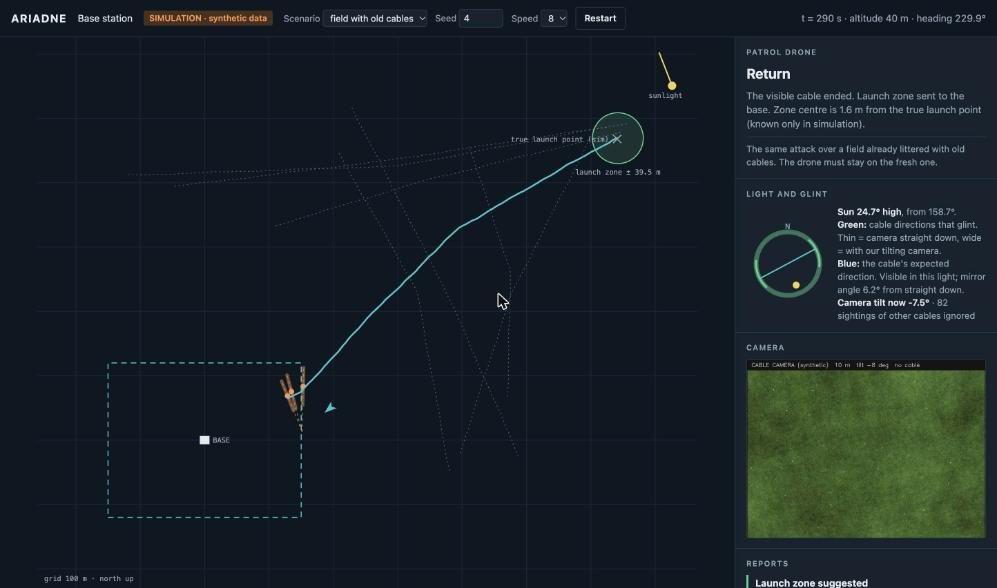
Lowy Institute, 6 Aug 2025 ↗ARIADNE is a patrol drone that spots an incoming drone, tells the base what it is and where, and, when that drone is guided by a fiber-optic cable, follows the cable back to where it was launched.
The idea in twenty seconds
Concept film: one ARIADNE mission, from the first sighting to the launch site.
The problem
Fiber-optic attack drones are steered through a thin glass fiber instead of radio. Jamming does nothing to them. Radio detectors hear nothing. The first warning is often the drone itself.
No
scalable countermeasures
“So far, there are no scalable countermeasures against these fibre-optic drones.”
Lowy Institute, 6 Aug 2025 ↗Up to 50%
of attack drones in some units
About 15–20% of Russian attack drones in mid-2025, by Ukraine’s Unmanned Systems Forces. Up to half in some units by 2026.
Sources in our project document ↗0.25 mm
of glass, left on the ground
The fiber stays where it fell after the flight. One end of it is the place the drone was launched from.
References ↗The opening
In February 2025 a Ukrainian brigade saw spent fiber glinting in low sun, flew along it by hand and found the launch crew. So the idea is proven.
Within months it was failing. The fields filled with old cable and nobody could tell new from old. And it had only ever worked when the sun happened to sit at the right angle.
We automate a tactic that worked by hand, and we fix the two reasons it stopped: clutter, and luck with the light.
Fix one
The trace starts from a drone the patrol has just seen, at the spot where it saw it. That is how it knows which cable among many is the new one.
Fix two
A cable glints towards exactly one angle. ARIADNE works it out from the sun and the cable’s direction, and tips its camera to it. Luck becomes method.
Also
After sunset it says the cable cannot be traced, and stays on patrol instead of guessing.
Always
The report shows the zone and the evidence behind it. A human confirms or rejects. Nothing else happens.
How it works
In our simulation the whole sequence takes about four and a half minutes. The clips are cut from the concept film.
01
The drone flies the perimeter of a protected position on its own. One operator, no flying by hand.
02
An incoming drone crosses its camera. The base sees a direction, a rough distance and the type of drone, with a picture. That is the early warning.
03
It flies to where the drone was seen, works out the one angle from which the cable glints, tips its camera to it and follows the cable, past the older ones.
04
Where the cable ends, the base gets a zone with a radius and the evidence behind it.
05
The duty officer confirms or rejects. The system informs and suggests. It takes no action on a zone.
Evidence
That is a rule in our repository, and it applies to this page. Every number below comes from running code, and all of it describes a simulation.
| Scenario | Zone reported | True point inside | Zone wrong | Median error |
|---|---|---|---|---|
| Good light | 17 of 20 | 17 | 0 | 2.5 m |
| Field with seven old cables | 17 of 20 | 14 | 3 | 27.4 m |
| 60 m of cable in shade | 17 of 20 | 17 | 0 | 2.1 m |
| Sun shining along the cable | 17 of 20 | 17 | 0 | 2.1 m |
| After sunset | 0 of 20 | n/a | 0 | n/a |
The cluttered field is the hardest case and the one that matters most: three times the true launch point fell outside the zone. After sunset the drone reports the attack and correctly declines to trace. Full report ↗
What comes next
Today ARIADNE traces reflective fiber in sunlight, in simulation. This is the road from there.
Where it was built
ARIADNE was built at the European Defense Tech Hackathon in Prishtina, Kosovo, on 20–22 November 2026: the first defence-focused hackathon of its kind in the country, with more than 200 participants from across Europe and feedback from people with operational experience.
Team
Computer science engineers from Bulgaria, working together as Wavsy.
We are looking for people who know this problem first-hand, and for a chance to test against real fiber, in real light.


